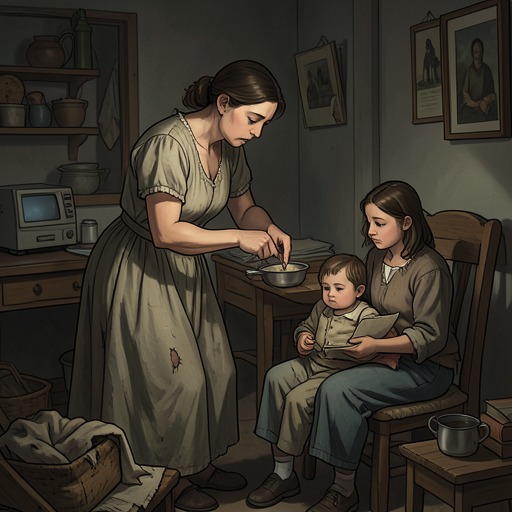
The stocking for the lighthouse keeper’s son
To the LighthouseThe stocking for the lighthouse keeper’s son is a small, unfinished garment through which the novel brings domestic care into contact with illness, uncertainty, and loss. Mrs Ramsay knits it as a gift for the lighthouse keeper’s little boy, whose hip is threatened by tuberculosis, and tries to judge its length against James’s leg. That intimate task links the prospect of a trip to The Lighthouse with the needs of people living in isolation; its shortness, and the later image of Mrs Ramsay’s clothes left behind in the empty house, give the modest object a wider significance as a trace of care that time cannot preserve intact.
A Gift for an Isolated Child
Mrs Ramsay is making the stocking for the lighthouse keeper’s son while the family considers whether a trip to The Lighthouse may take place. The garment is reddish brown, and she works it with a small twist of the yarn as she tries to finish it that night. If the family does go, she hopes to send it the next day. The prospect of the journey is not secure: she insists that the weather may improve, while Mr Ramsay says there is no chance of going the following day. The stocking’s completion therefore depends on a future that remains in doubt.
The gift belongs to a larger bundle of practical comforts Mrs Ramsay imagines taking to the lighthouse. Along with the stocking, she proposes old magazines and tobacco, or whatever useful things are lying about and not wanted. Her concern is not abstract charity: she pictures the lighthouse keepers confined for a month or longer on a rock the size of a tennis lawn, without letters or newspapers or company, and exposed to storms that keep them indoors. She asks her daughters to imagine the loneliness of that life, including separation from a wife and uncertainty about children at home. In this account, the stocking is one concrete response to the deprivation of a remote household.
Its intended recipient is defined by vulnerability as well as by distance. The boy’s hip is threatened by tuberculosis, and Mrs Ramsay’s knitting is meant for him rather than for one of her own children. Her kindness thus reaches beyond her household, although it is expressed through the familiar domestic act of making clothing. The scene does not give the child a voice or describe his experience directly; instead, his illness and isolation enter the family’s attention through Mrs Ramsay’s imagined gift and her account of the keepers’ circumstances.
Measuring, Misdirection, and Domestic Labor
Mrs Ramsay checks the stocking by holding it against James’s leg. The measurement turns a general intention into a precise practical problem: the garment is at least half an inch too short, even allowing that Sorley’s little boy may be less well grown than James. She states the result plainly: “It’s too short,” and then emphasizes, “ever so much too short.” The difference is small in measurement but decisive for the object’s usefulness. Her care depends on noticing a concrete mismatch, not merely on the good intention to give.
James resists being used as a measure. He is jealous and fidgets because he dislikes serving as the measuring block for the lighthouse keeper’s child. Mrs Ramsay tells him to stand still, first with a reminder and, after her thoughts turn to the Swiss maid’s dying father, with sharper severity. He straightens his leg, and she completes the measurement. The scene lets the work of making the gift unfold amid competing demands: James’s need for his mother’s attention, her concern for another child, and the interruption of painful knowledge about illness closer to home.
That knowledge comes through the maid’s words about the beauty of the mountains at home. Mrs Ramsay knows that the woman’s father is dying of throat cancer and that there is no hope. The recollection briefly sharpens her irritation, and she speaks sternly to James before returning to the measurement. The stocking consequently sits within a household where care is not a simple, serene virtue: it must be carried out amid grief, frustration, and divided attention. Mrs Ramsay’s tenderness for the lighthouse keeper’s family does not cancel the immediate strain of managing her own children and household.
Care Beyond the Household
Mrs Ramsay’s concern for the lighthouse keepers extends beyond the garment. She imagines their daily confinement, the repeated sight of waves, the danger of birds striking the lamp in a storm, and the inability to go outside without risking being swept into the sea. Her appeal to her daughters to consider how such isolation would feel converts sympathy into a practical question: what comforts can be taken to them? The stocking is part of that answer, alongside reading matter and tobacco, and its usefulness depends on completing and delivering it in time.
The episode also places private generosity beside public need. Mrs Ramsay resents the lack of a hospital on the island and the delivery of milk in London that is brown with dirt. She imagines establishing a model dairy and a hospital, but asks how she could do so while caring for her children; perhaps there will be time when they are older and at school. Her ambitions reveal a wider sense of responsibility, while the stocking shows the scale at which she can act in the present. The garment offers a direct, limited kindness where the institutional changes she wants remain unrealized.
Yet the scene does not make the recipient’s illness a fully represented life. The boy is introduced through his threatened hip and the proposed act of giving; the narrative’s attention stays with Mrs Ramsay’s labor, judgments, and feelings. The stocking therefore carries both the force and the limit of this form of care: it makes another family’s hardship imaginable to the Ramsays, but the child himself remains at a distance, known through the needs attributed to him and the object prepared on his behalf.
The Unfinished Gift in the House of Loss
The stocking’s immediate history remains unresolved in the evidence: Mrs Ramsay discovers that it is too short, and the proposed trip to The Lighthouse is uncertain. Years later, however, the narrative returns to Mrs Ramsay through the house’s abandoned possessions. Mrs McNab finds clothes left in the bedrooms, including Mrs Ramsay’s old grey gardening cloak; there are also boots and shoes, a brush and comb, and drawers full of handkerchiefs and ribbons. The family has not returned for years, and Mrs Ramsay is dead. This later inventory gives domestic things the force of evidence: they remain in place after the person whose labor and presence made them part of everyday life is gone.
The abandoned clothing is not specifically identified as the stocking, so the garment should not be mistaken for an object that is explicitly recovered or tracked through the later years. Its significance comes instead from the contrast between the immediate scene of making and the later scene of neglect. Earlier, Mrs Ramsay handles the unfinished garment, measures it carefully, and plans its use; later, her clothes survive in cupboards while the house itself is damp, mouldy, and in need of repair. Her attentive work belongs to the same domestic world whose material traces time leaves behind.
As an object in the novel, the stocking makes care visible without turning it into an abstract ideal. Its recipient’s illness, its intended journey, its exact shortage, and James’s resistance all give the act specific circumstances. Set against Mrs Ramsay’s larger, frustrated wish to improve public health, it also marks the reach and limits of her influence: she can knit, measure, imagine the keepers’ confinement, and try to send practical comforts, but she cannot command the weather, resolve the island’s lack of a hospital, or halt the passage from lived domestic labor to abandoned belongings.